Project 03
H-GATE: Harris-Hawks-Optimized Gradient-boosted Attention-Transformer Ensemble
A five-class malicious-URL classifier built as a stacking ensemble, evaluated out-of-fold and compared honestly against a strong XGBoost baseline.
- Apr to May 2026
- Python
- PyTorch
- FT-Transformer
- XGBoost
- +4

Context
Problem
A URL classifier that flags too much is as useless as one that flags too little. Security teams need five-way labelling: benign, defacement, malware, phishing, and spam, with a false-positive rate low enough that analysts keep trusting the alerts.
Reading
Research & prior art
- 01
Heidari et al. (2019), “Harris Hawks Optimization: Algorithm and Applications,” Future Generation Computer Systems.
HHO is a gradient-free, population-based optimiser. I used it for the mixed integer and continuous search space around the tree models, where a full grid search would have been too expensive. Its stochasticity is why the final comparison rests on fixed folds, not on the best single run.
- 02
Gorishniy et al. (2021), “Revisiting Deep Learning Models for Tabular Data,” NeurIPS.
The FT-Transformer tokenises each feature and applies self-attention. It gave the ensemble a non-tree learner that could model feature interactions the boosted trees miss. It was also the most expensive branch to train, which is why it is one of four models rather than the whole classifier.
- 03
Chen & Guestrin (2016), “XGBoost: A Scalable Tree Boosting System,” KDD; Ke et al. (2017), “LightGBM: A Highly Efficient Gradient Boosting Decision Tree,” NeurIPS; Prokhorenkova et al. (2018), “CatBoost: Unbiased Boosting with Categorical Features,” NeurIPS.
The three boosted-tree libraries are the strong tabular baselines. XGBoost is the reference, LightGBM handled the focal-loss objective cleanly, and CatBoost’s ordered boosting helped with the lexical features. The ensemble only earns its complexity if it beats the best single tree model.
- 04
Lin et al. (2017), “Focal Loss for Dense Object Detection,” ICCV.
Focal loss down-weights easy examples so the LightGBM branch can focus on the rare malicious classes without discarding the majority class. It was paired with per-class thresholds, because a loss change alone does not choose the operating point.
- 05
Chawla et al. (2002), “SMOTE: Synthetic Minority Over-sampling Technique,” JAIR.
SMOTE-NC extends SMOTE to mixed numeric and categorical features. I ran it inside each training fold so synthetic rows never crossed the fold boundary; that detail matters more than the oversampling ratio.
- 06
Lundberg & Lee (2017), “A Unified Approach to Interpreting Model Predictions,” NeurIPS.
SHAP gave per-class feature attributions for the final ensemble. It is the difference between a leaderboard number and a model an analyst can question.
Trade-offs
Approaches compared
Vanilla XGBoost
- Strengths
- Strong tabular baseline, fast to tune, well understood, and already reaches 0.9839 macro-F1 on the same folds.
- Limits
- One model family. It cannot exploit the complementary errors of a transformer or a differently regularised tree model.
- Verdict
- Kept as the reference. The ensemble has to beat this, not a weak baseline.
Four-model stacking with a logistic meta-learner
- Strengths
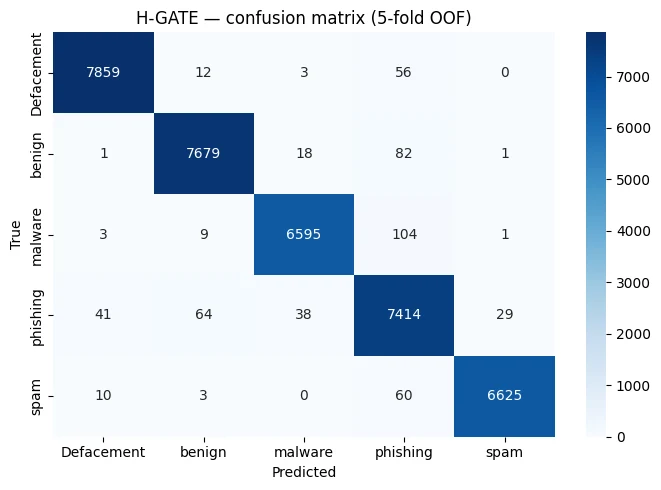
- Combines FT-Transformer, focal-loss LightGBM, XGBoost, and CatBoost; reaches 0.9856 macro-F1 and 0.37% macro-FPR out-of-fold.
- Limits
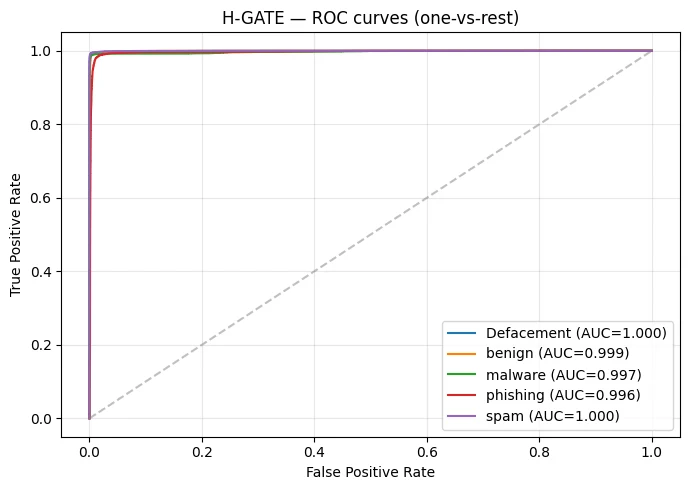
- Macro-AUC is lower than vanilla XGBoost (0.9984 against 0.9993), the F1 gain is 0.17 percentage points, and out-of-fold numbers on the same dataset flatter every model.
- Verdict
- A narrow, honest win on F1 and false positives, not a decisive one. I would not present it as a new state of the art.
HHO versus grid or random search
- Strengths
- HHO searches a mixed hyperparameter space without gradients and can explore configurations that a small grid would not reach.
- Limits
- Stochastic and expensive. A single search run is not evidence, and the budget was small relative to the number of models.
- Verdict
- Part of the method, not the evidence. The claim rests on the fixed-fold comparison with vanilla XGBoost.
Method
Approach
- 01
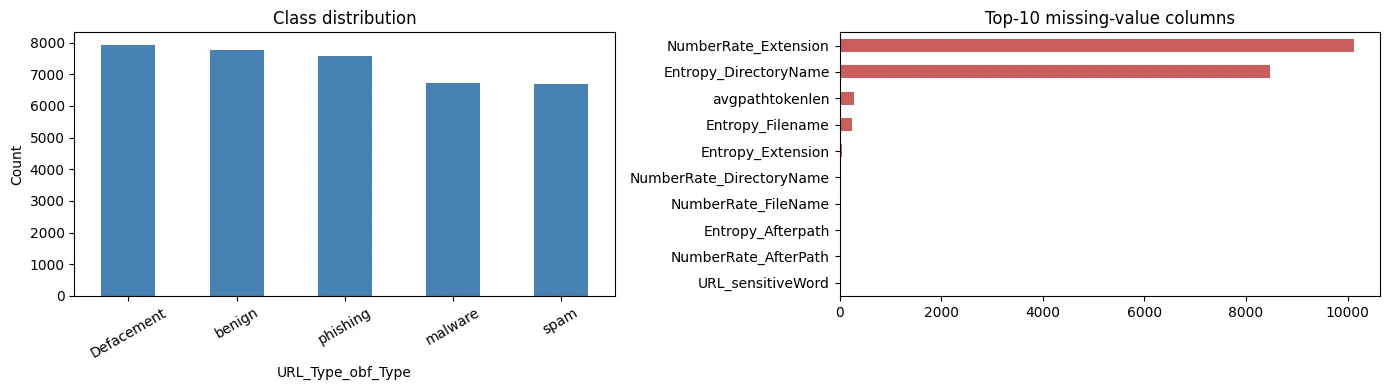
Start from ISCX-URL2016: 36,707 URLs across five classes, with a severe class imbalance.
- 02
Train four base models: an FT-Transformer, a focal-loss LightGBM, XGBoost, and CatBoost.
- 03
Feed their out-of-fold predictions to a logistic meta-learner, with SMOTE-NC and per-class thresholds tuned to a recall floor of 0.90.
- 04
Search hyperparameters with Harris Hawks optimisation and explain the result with SHAP.
- 05
Evaluate with five-fold out-of-fold predictions on the full dataset, not an independent test set, a distinction the numbers depend on.
Contribution
What I personally built
- I built the FT-Transformer branch, the focal-loss LightGBM branch, and the XGBoost and CatBoost baselines, then wired them into a five-fold out-of-fold stack.
- I implemented the SMOTE-NC step inside each training fold, the per-class threshold search against a 0.90 recall floor, and the logistic meta-learner.
- I ran the Harris Hawks search, the SHAP analysis, and the comparison against vanilla XGBoost; the macro-AUC caveat in the reflection comes from that comparison.
Evidence
Results
0.9856
Macro-F1
Stacking ensemble, five-fold out-of-fold
0.37%
Macro-FPR
False positives averaged across classes
0.9839
Baseline macro-F1
Vanilla XGBoost on the same folds
0.9984
Macro-AUC
Stacking ensemble; vanilla XGBoost scored 0.9993
Reflection
What I would do differently
The ensemble's macro-F1 was 0.17 percentage points above a strong vanilla XGBoost baseline, while its macro-AUC was lower (0.9984 against 0.9993). That is not a decisive win, and I would not present it as one. I would add a time-based held-out set next, because out-of-fold numbers on the same dataset flatter every model in the comparison.