Project 02
Spell Caster: Voice-Driven RPG with Emotion-Aware Spell Casting
A voice-controlled spellcasting prototype that hears the spell and the emotion behind it, then hands both to the game.
- Apr to May 2026
- Python
- PyTorch
- Whisper-Small
- LoRA
- +4

Context
Problem
Voice control in a game is usually a menu shortcut. We wanted the spell and the emotion behind it to matter, which means transcribing a short, noisy utterance and classifying the speaker's affect at the same time, on a laptop CPU.
Reading
Research & prior art
- 01
Radford et al. (2023), “Robust Speech Recognition via Large-Scale Weak Supervision,” ICML.
Whisper's weak supervision gave us a transcription model that handled short, noisy game commands without a domain-specific corpus. We kept the base model frozen and adapted only the emotion head, because full fine-tuning would have given up the data and latency advantages.
- 02
Gulati et al. (2020), “Conformer: Convolution-augmented Transformer for Speech Recognition,” Interspeech.
The Conformer's convolution blocks capture local acoustic detail while attention models longer context. We built a 5.05M-parameter version from scratch as the CPU-friendly comparison; it was small enough to export, but not accurate enough to replace Whisper.
- 03
Hu et al. (2021), “LoRA: Low-Rank Adaptation of Large Language Models,” ICLR.
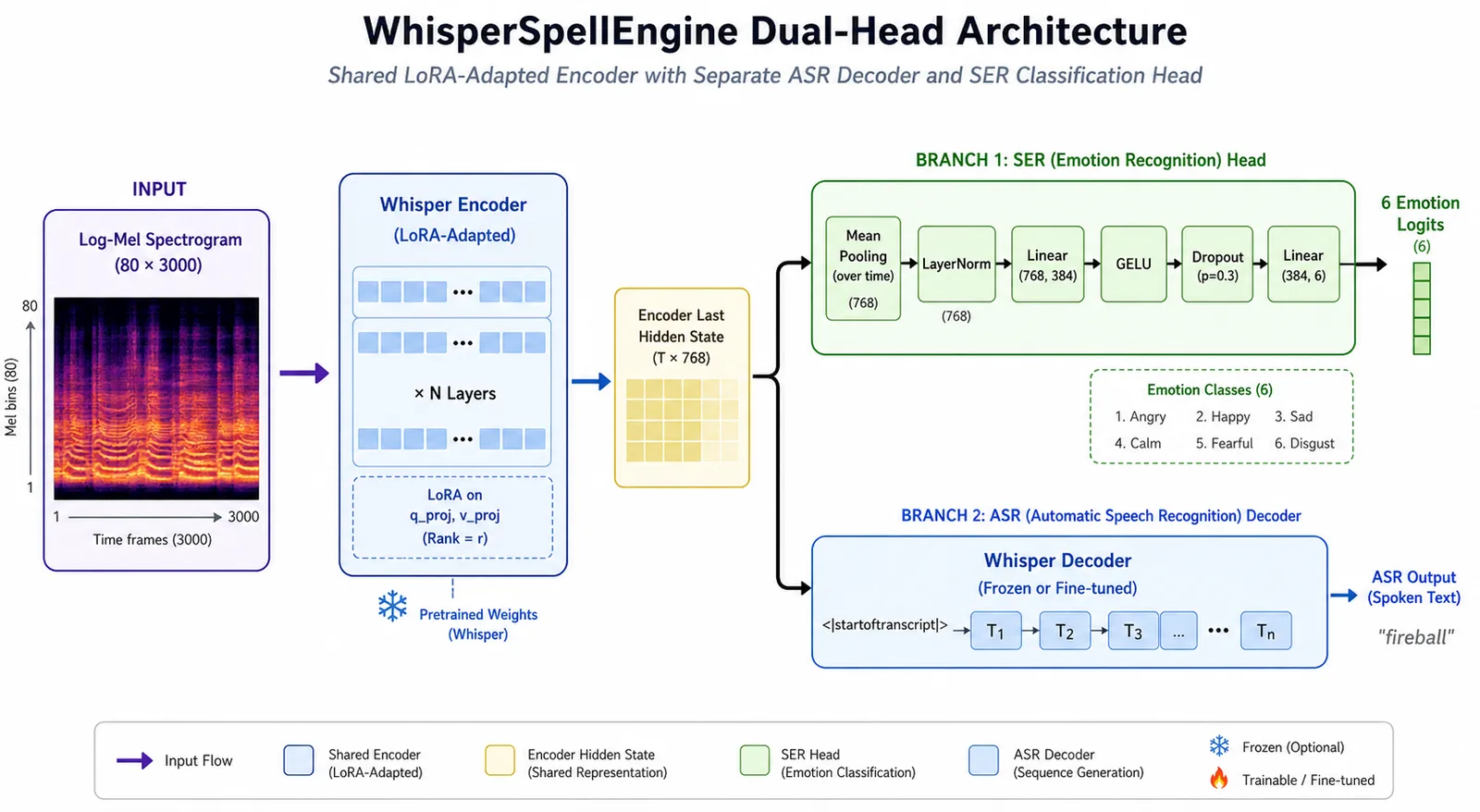
LoRA let us train 0.73% of Whisper-Small's parameters for the six-class emotion head. The important detail is that the transcription weights stayed stock; only the emotion adapter was fine-tuned.
- 04
Cao et al. (2014), “CREMA-D: Crowd-sourced Emotional Multimodal Actors Dataset,” IEEE Transactions on Affective Computing.
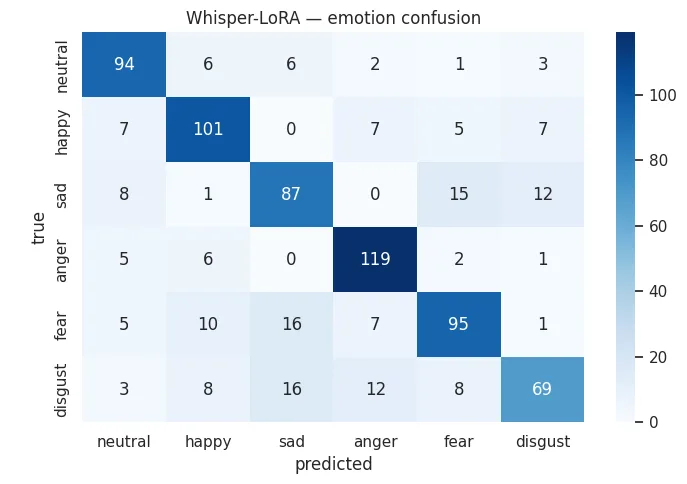
CREMA-D gave us six acted emotions with controlled variation in speaker, sentence, and intensity. It is cleaner than in-game speech, so the 0.7543 F1 is an upper bound on what the game would see.
- 05
Kendall et al. (2018), “Multi-Task Learning Using Uncertainty to Weigh Losses for Scene Geometry and Semantics,” CVPR.
Kendall weighting let the ASR and SER heads contribute to one loss without hand-tuning a fixed ratio. It is a principled alternative to a grid search over loss weights.
Trade-offs
Approaches compared
Whisper-Small with a LoRA-tuned emotion head
- Strengths
- WER 0.0015 and emotion F1 0.7543 on the evaluation. The base model is robust to short, noisy commands, and only 0.73% of its parameters are trainable.
- Limits
- The full Whisper path is heavier on CPU, and the report measured only the Conformer's latency, not Whisper's.
- Verdict
- The quality reference and the model I would start from. The missing Whisper latency measurement is the main gap.
From-scratch Conformer (5.05M parameters)
- Strengths
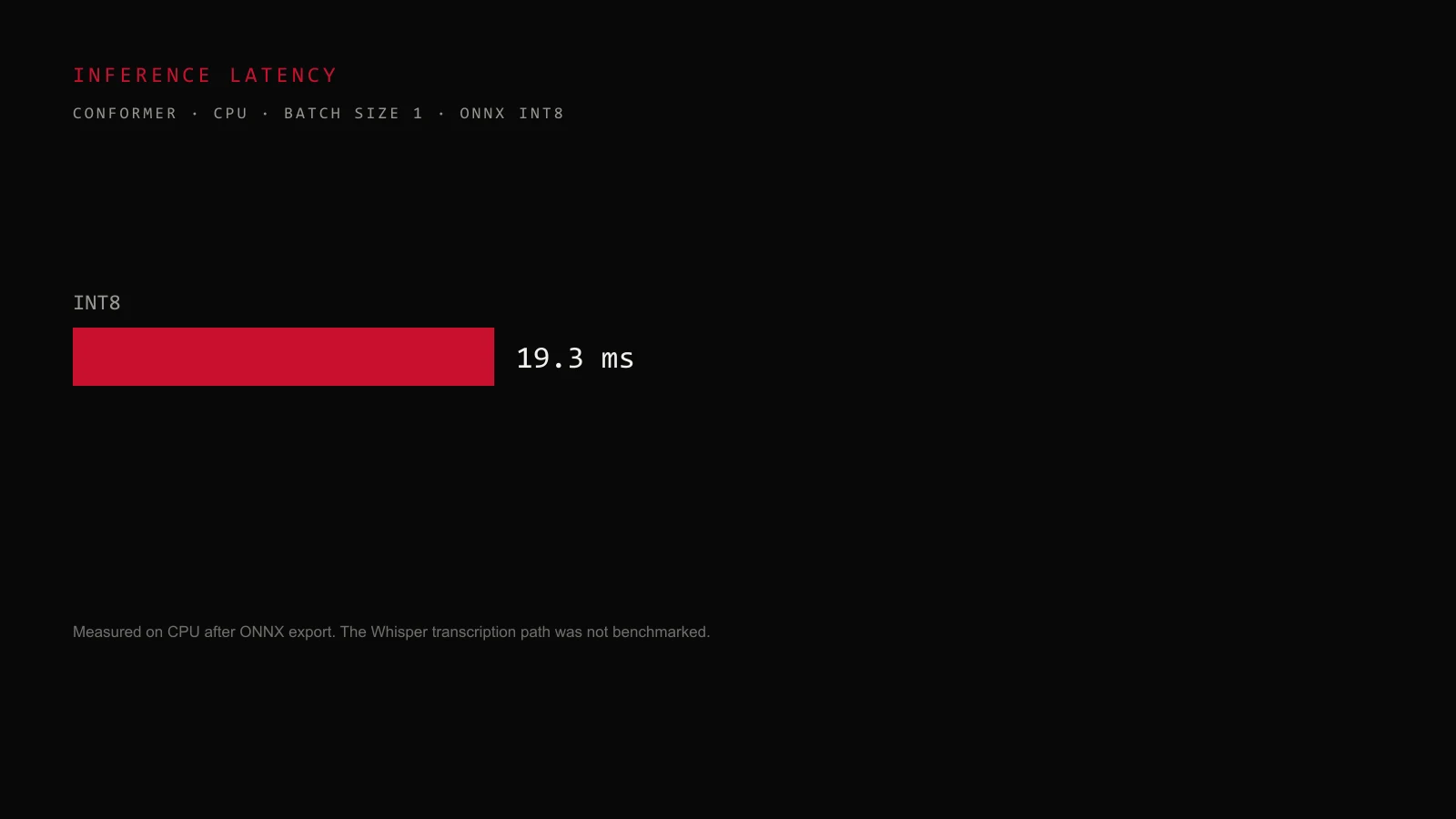
- WER 0.1128, emotion F1 0.5253, and 19.3 ms for a batch-1 CPU forward pass after ONNX INT8 export.
- Limits
- Much worse transcription and emotion quality than Whisper. Training from scratch on this data budget did not close the gap.
- Verdict
- The CPU-friendly comparison, not the better model. Its latency is real, but it is not worth the accuracy loss for the game.
Method
Approach
- 01
Transcribe with Whisper-Small as the base model. LoRA is fine-tuned for the six-class emotion head only; the transcription weights are the stock ones.
- 02
Train a second, smaller Conformer (5.05M parameters) from scratch with CTC and an attention-pooling SER head, as a CPU-friendly comparison.
- 03
Combine the two objectives with Kendall uncertainty weighting, then export the Conformer to ONNX INT8.
- 04
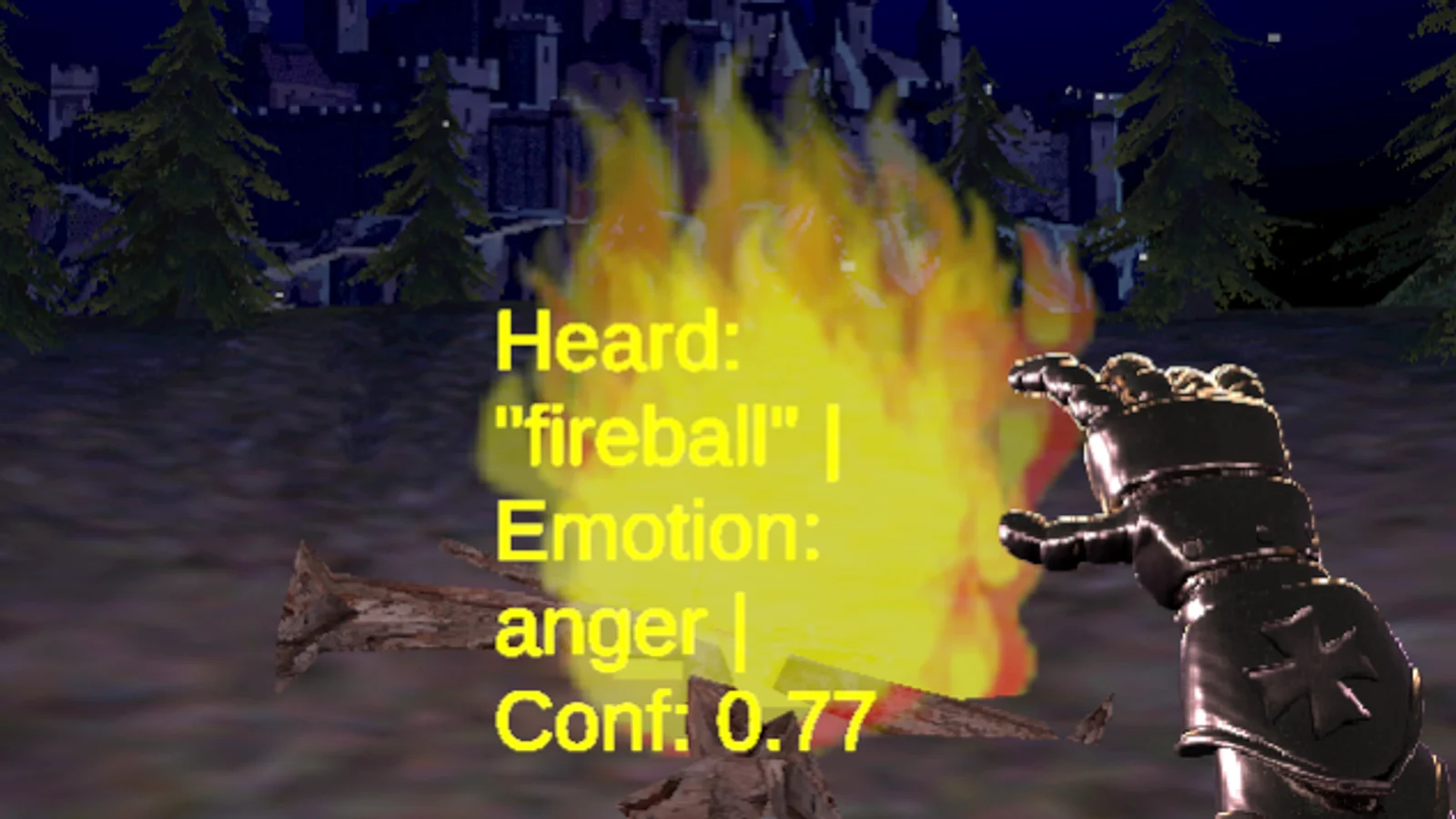
Return spell and emotion from a single FastAPI endpoint, falling back to neutral below 0.35 confidence.
- 05
Integrate that endpoint into the Unity game with my teammate, who built the game mechanics and the C# client.
Contribution
What I personally built
- I built the audio pipeline: Whisper-Small with a LoRA-tuned six-class emotion head, and the from-scratch Conformer with CTC and an attention-pooling SER head.
- I combined the objectives with Kendall uncertainty weighting, exported the Conformer to ONNX INT8, and served spell and emotion from one FastAPI endpoint with a neutral fallback below 0.35 confidence.
- I integrated the endpoint with my teammate's Unity client. The game mechanics and the C# client were my teammate's work.
Evidence
Results
0.754
Emotion F1
Whisper-Small with a LoRA-tuned emotion head
0.0015
WER (Whisper)
Whisper-Small, stock transcription weights
0.113
WER (Conformer)
From-scratch Conformer, LibriSpeech
19.3 ms
CPU latency
Conformer, batch size one, ONNX INT8
Reflection
What I would do differently
The Conformer was the more interesting model to build and the worse one to ship: its WER was 0.113 against Whisper's 0.0015, and its only advantage was running comfortably on CPU. I would start from the strongest base model and spend the effort on the task-specific head, then measure latency on the path users actually take rather than on a benchmark in isolation. The report never measured the Whisper path on CPU, so the latency comparison is incomplete.