Project 01
Pocket OMR: End-to-End Optical Mark Recognition with Handwritten Character Identification
A phone photo of an exam sheet becomes a graded answer sheet: rectification, region segmentation, bubble reading, and character recognition in one pipeline.
- Mar to Jun 2026
- Python
- PyTorch
- YOLOv8m-seg
- OpenCV
- +4

Context
Problem
Grading multiple-choice exams means either marking hundreds of sheets by hand or buying a dedicated scanner. A phone camera is the only hardware most schools already have, but a photograph brings perspective, shadow, and rotation that a scanner never does.
Reading
Research & prior art
- 01
Ultralytics (2023), “YOLOv8 segmentation models.”
YOLOv8's segmentation head gave us one model for the eight form regions instead of a hand-built contour pipeline. The 99.5 mAP@50 is on our own annotated photographs, not a public benchmark, so it measures fit to our capture conditions.
- 02
Howard et al. (2019), “Searching for MobileNetV3,” ICCV.
MobileNetV3-Small gave us an efficient bubble classifier: 98.98% accuracy at 1.78M parameters. The small footprint is why it was worth testing for a phone-photo pipeline, even though the team kept CNN_OMR for the final service.
- 03
Tan & Le (2021), “EfficientNetV2: Smaller Models and Faster Training,” ICML.
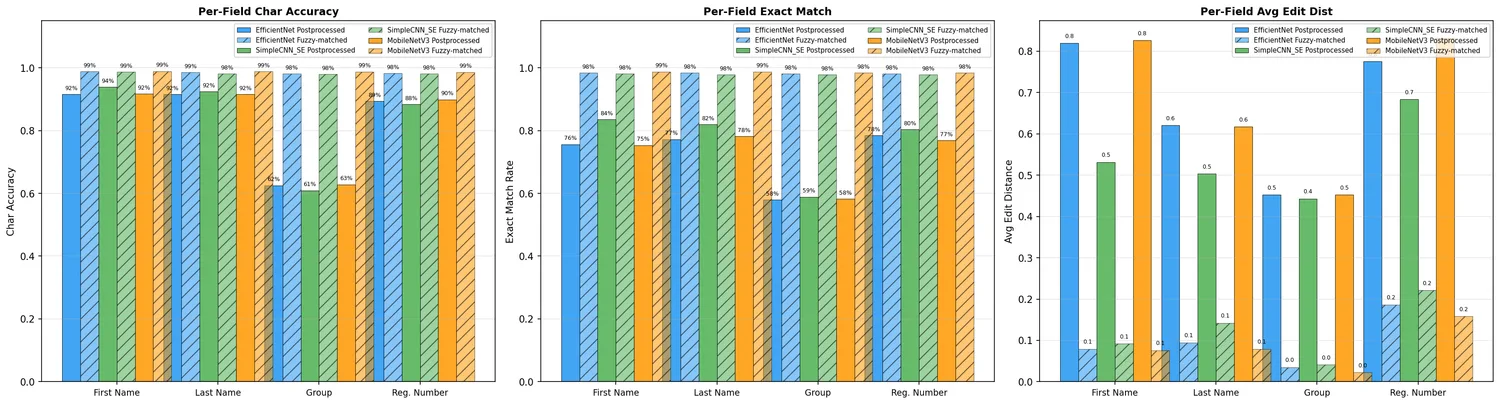
The character ensemble used EfficientNetV2-S alongside SimpleCNN_SE and MobileNetV3-S. The ensemble was about covering different handwriting failure modes, not about one backbone winning.
- 04
Cohen et al. (2017), “EMNIST: Extending MNIST to Handwritten Letters,” IJCNN.
EMNIST gave the character models a pretraining distribution closer to handwritten names and IDs than MNIST digits alone. It is still cleaner than a phone photo of a form.
- 05
Bradski (2000), “The OpenCV Library,” Dr. Dobb's Journal of Software Tools.
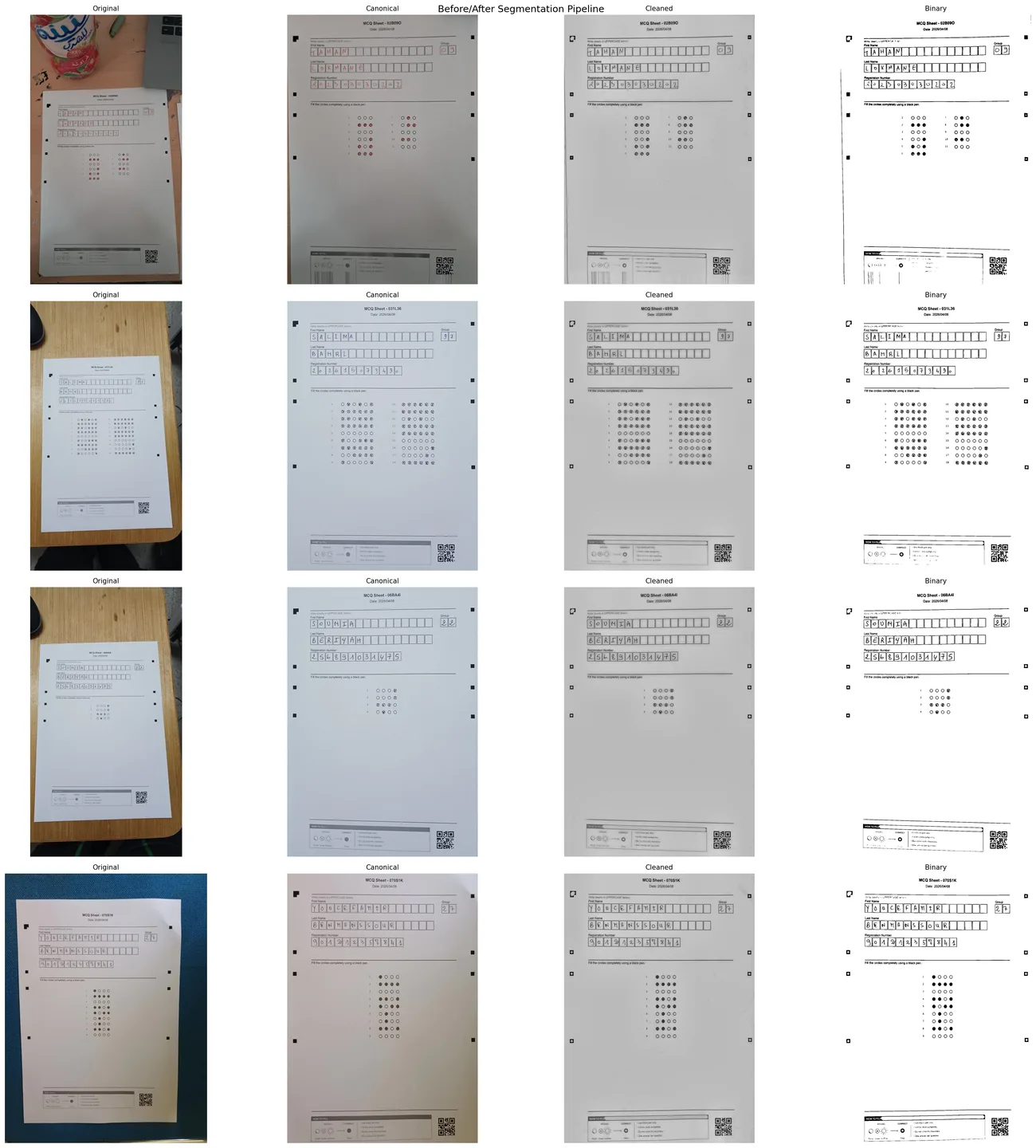
OpenCV supplied the deterministic half of the pipeline: marker detection, perspective warp, shadow removal, and binarisation. Those operations are cheap and explainable, and they stayed even after deep segmentation replaced the contour stage.
Trade-offs
Approaches compared
OpenCV rectification and contour-based region detection
- Strengths
- Deterministic, needs no training data, and is easy to debug. It handled markers, perspective, and binarisation with classical operations.
- Limits
- It took twelve iterations to make robust and still broke on shadows, folds, and unusual layouts; every new capture condition added another special case.
- Verdict
- Kept for rectification and normalisation, replaced by YOLOv8m-seg for region segmentation.
YOLOv8m-seg region segmentation
- Strengths
- 99.5 mAP@50 on the annotated form regions. One model replaced the brittle contour stage and generalised across capture conditions.
- Limits
- Needs annotated photographs and a GPU at training time; the metric is on our own dataset, not a public benchmark.
- Verdict
- The right trade for this pipeline. The OpenCV stage stayed where it is deterministic and cheap.
Bubble reading: CNN_OMR, MobileNetV3-Small, and YOLOv8s
- Strengths
- CNN_OMR was the team's chosen classifier. MobileNetV3-Small reached 98.98% accuracy at 1.78M parameters. YOLOv8s offered end-to-end detection.
- Limits
- YOLOv8s was rejected at 30.2% answer accuracy (94% recall, 57 to 59% precision) because detecting a bubble is not reading which one is filled. The MobileNetV3-Small result is a candidate, not the shipped model.
- Verdict
- Keep detection and classification separate. The small classifier is promising, but the team kept CNN_OMR for the final service.
Character ensemble versus a single backbone
- Strengths
- Soft voting across EfficientNetV2-S, SimpleCNN_SE, and MobileNetV3-S covers different handwriting failure modes.
- Limits
- Three models cost more to train and serve, and no per-model ablation is recorded, so the ensemble's gain is not isolated.
- Verdict
- Reasonable for accuracy, but the next step is an ablation, not another backbone.
Method
Approach
- 01
Normalise the sheet first: detect the printed markers, warp to 1240×1754, correct QR orientation, remove shadows, and binarise with CLAHE and Otsu so every later stage sees a flat, upright page.
- 02
Segment eight form regions with YOLOv8m-seg, then classify each bubble. The team kept CNN_OMR for the final service; I trained the MobileNetV3-Small alternative.
- 03
Read printed and handwritten fields with a three-model character ensemble (EfficientNetV2-S, SimpleCNN_SE, MobileNetV3-S), pre-trained on EMNIST and combined by soft voting.
- 04
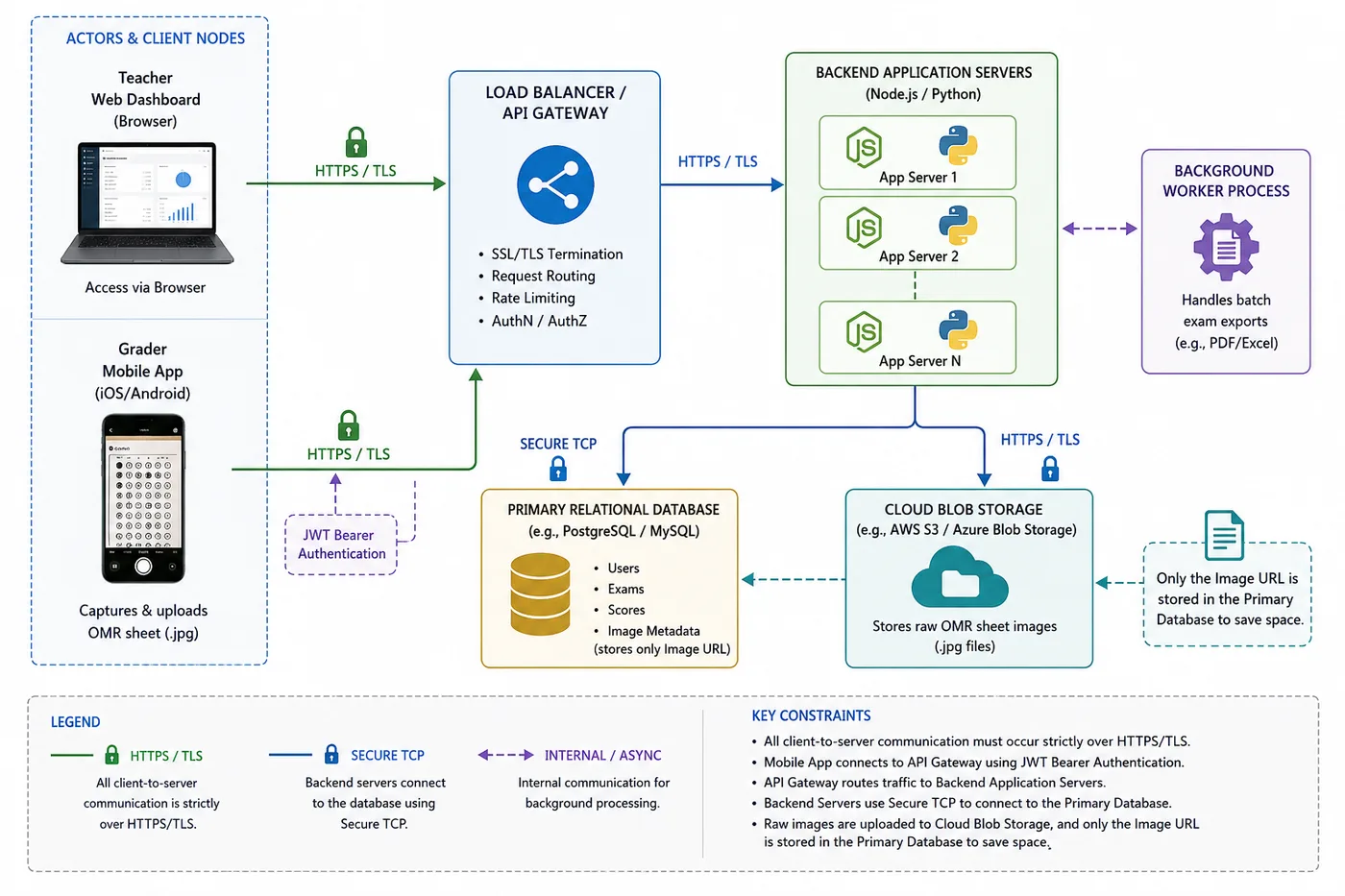
Serve the pipeline through FastAPI with React and Flutter clients, containerised with Docker and served on a T4.
- 05
The team also trained a YOLOv8s bubble detector end-to-end and rejected it: it reached 30.2% answer accuracy, because detecting a bubble is not the same as reading which one is filled.
Contribution
What I personally built
- All six of us shared data collection, cleaning, and annotation; the dataset was custom-collected, so that work was the project.
- I led the box-detection approaches: the OpenCV marker and region pipeline, the per-bubble box extraction, and the detection training pipeline that fed YOLOv8m-seg.
- I built the OpenCV rectification and segmentation stages and trained the MobileNetV3-Small bubble classifier (98.98% accuracy, 1.78M parameters). The team kept CNN_OMR for the final service.
- The YOLOv8s end-to-end detector was a team comparison, not my classifier; I keep it in the results because it explains why detection and classification stayed separate.
Evidence
Results
99.5
mAP@50
Region segmentation, YOLOv8m-seg
98.98%
Bubble accuracy
MobileNetV3-Small candidate, 1.78M parameters
98.31
Bubble F1
MobileNetV3-Small candidate
30.2%
Answer accuracy
Rejected YOLOv8s bubble detector

Reflection
What I would do differently
The component metrics looked excellent while the end-to-end answer sheet was often wrong. A YOLOv8s detector that skipped segmentation scored 30.2% answer accuracy even though the segmentation model scored 99.5 mAP@50. I would instrument the full sheet from day one, keep a held-out set of real photographs, and treat correct answers per sheet as the only number that decides whether the pipeline works. The MobileNetV3-Small result looked strong in isolation, but the end-to-end sheet is what matters.